EXPLAINABLE CYBER RISK DECISIONING
Turn fragmented security data into explainable risk decisions.

Turn fragmented security data into explainable risk decisions.

VantagePoint Cyber transforms fragmented vulnerability, asset, identity, threat intelligence, and business context into prioritized, explainable risk decisions. Instead of another severity score, security teams gain the evidence they need to understand what matters, why it matters, and which actions reduce exposure fastest.

VantagePoint Cyber transforms fragmented vulnerability, asset, identity, threat intelligence, and business context into prioritized, explainable risk decisions. Instead of another severity score, security teams gain the evidence they need to understand what matters, why it matters, and which actions reduce exposure fastest.

HOW IT WORKS

From fragmented security data to prioritized action.

VantagePoint Cyber works with the security tools and data you already have, adding the context and decision intelligence needed to understand risk and reduce exposure.

01

Ingest Existing Data

Ingest existing security, vulnerability, and asset data from the tools you already use.

02

Correlate Risk Context

Automatically correlate vulnerabilities, assets, environmental context, identities, and threat intelligence into explainable cyber risk decisions.

03

Prioritize and Act

Prioritize the actions that reduce exposure the most and take action directly from the VantagePoint Cyber platform.

The real bottleneck

Security teams don’t have a visibility problem. They have a decision problem.

Too Many Findings

Organizations receive thousands of vulnerability findings every day, making it difficult to determine which issues meaningfully increase enterprise risk.

Disconnected Security Data

Security context is scattered across vulnerability scanners, asset inventories, identity systems, threat intelligence, and business applications.

Unclear Priorities

Security teams need defensible, evidence-backed decisions—not another severity score—to align remediation with business risk.

Platform

One Decision Platform. Four Intelligence Engines.

Contextual Risk Prioritization

Correlate vulnerability metadata with business context, asset criticality, exploitability, and environmental exposure.

Predictive Exploitability

Estimate which vulnerabilities are most likely to be exploited before they appear on known exploited vulnerability lists.

Attack Path Intelligence

Understand how attackers can realistically chain vulnerabilities, identities, and network exposure into material enterprise risk.

Risk Reduction Simulation

Model remediation strategies before assigning work to understand which actions reduce the greatest amount of exposure.

Product surfaces

Built around the decisions security leaders need to make and defend.

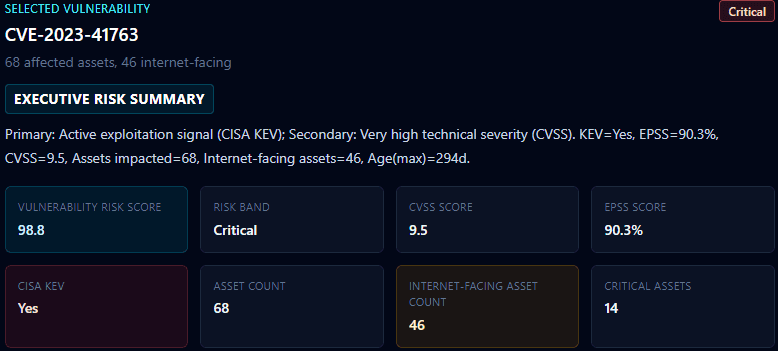
Executive Dashboard

Executive visibility into enterprise cyber exposure, prioritization, and remediation progress.

Watch Platform Preview

Attack Path Explorer screenshot

Watch Platform Preview

Attack Path Explorer

Visualize realistic attacker movement across vulnerabilities, identities, assets, and business systems.

Exploit Prediction

Identify vulnerabilities with the greatest likelihood of exploitation using predictive models trained on historical exploit activity.

Exploit Prediction screenshot

Watch Platform Preview

Risk Reduction Simulation screenshot

Watch Platform Preview

Risk Reduction Simulator

Understand how remediation decisions reduce enterprise exposure before implementation.

FEDERAL VULNERABILITY OPERATIONS

CISA BOD 26-04 — Operationalized.

VantagePoint Cyber turns CISA BOD 26-04 from policy into an operational vulnerability-response workflow.

The platform brings together KEV status, CISA SSVC intelligence, asset exposure, and technical impact to determine the required action, establish the governing remediation timeline, coordinate response, and preserve the evidence behind every decision.

See BOD 26-04 in VantagePoint

Risk-Based Policy Decisions

Evaluate vulnerability and asset evidence against BOD 26-04 decision logic to determine the appropriate response.

Risk-Based Policy Decisions

Evaluate vulnerability and asset evidence against BOD 26-04 decision logic to determine the appropriate response.

Governing Remediation Timelines

Translate each decision into an actionable remediation requirement with clear clock, due-state, and priority visibility.

Governing Remediation Timelines

Translate each decision into an actionable remediation requirement with clear clock, due-state, and priority visibility.

Forensic Response

For scenarios requiring forensic triage, initiate and track a dedicated response workflow separately from vulnerability remediation.

Forensic Response

For scenarios requiring forensic triage, initiate and track a dedicated response workflow separately from vulnerability remediation.

Decision to Action

Carry decisions through remediation workflows, Jira actions, decision history, evidence provenance, and portfolio-level reporting.

Decision to Action

Carry decisions through remediation workflows, Jira actions, decision history, evidence provenance, and portfolio-level reporting.

From CISA evidence to policy decision to operational action — in one explainable workflow.

Why VantagePoint

From fragmented findings to defensible decisions.

Traditional Security Approach

• Thousands of alerts

• CVSS-first prioritization

• Disconnected security tools

• Manual analyst correlation

• Reactive remediation planning

VantagePoint Cyber

• Explainable risk decisions

• Business-aware prioritization

• Unified security context

• Attack-path intelligence

• Risk reduction simulations

Explainability

Explainable by Design

Every risk score, attack path, and recommendation is backed by transparent evidence, contextual reasoning, and business impact. Security teams should never have to trust a black box.

Evidence-backed prioritization

Transparent decision rationale

Executive-ready remediation guidance

Early access

Seeking Design Partners

We’re partnering with a limited number of enterprise organizations to help shape the future of explainable cyber-risk decisioning through collaborative pilots and design partnerships.